
Botulinum toxin (Botox) – what is it and how does it work?
Summary:
Botulinum toxin (Botox) is a neurotoxin that temporarily prevents muscle contraction by blocking the release of acetylcholine at the neuromuscular junction. Botulinum toxin is used for both medical treatments and cosmetic purposes, such as the treatment of expression lines.
Botox (onabotulinumtoxin A) is the best-known brand name for botulinum toxin. Other brand names for the drug include Dysport (abobotulinumtoxin A) and Xeomin (inkobotulinumtoxin A).
Botulinum toxin is one of the best-known active ingredients used in aesthetic treatments. Although the word “Botox” is often associated with wrinkle treatment, it is originally a medical product used to treat a variety of conditions.
In this article, I explain what botulinum toxin is, how it works at the tissue level, and what it is used for.
Author
Ville Männistö is an oral and maxillofacial surgeon who specializes in aesthetic botulinum toxin treatments and disorders of the masticatory muscles.
Her clinical work focuses on understanding facial muscle function, anatomy, and the mechanisms of action of botulinum toxin in both aesthetic and medical treatments.
He is also a member of a research group studying disorders of the masticatory muscles and the effects of botulinum toxin treatments. The study has been published in an international peer-reviewed scientific journal.
The study is available in the PubMed database:
Temporomandibular disorders and masticatory muscle dysfunction – Journal of Craniofacial Surgery
Why does this matter?
The outcome of Botox treatments depends on a thorough understanding of anatomy and proper dosing. Even within the same muscle group, different individuals may have different patterns of muscle activity. This affects both the treatment plan and the final result.
What is botulinum toxin?
Simply put: Botulinum toxin is a neurotoxin used in medicine in very small doses to reduce muscle activity.
Medically: Botulinum toxin is a neurotoxin produced by the bacterium Clostridium botulinum. It is one of the best-known neurotoxins. In medicine, it is used in very small, precisely measured doses, in which case it acts not as a toxin but as a medicine.
There are several different types of botulinum toxins (A–G), of which type A is the most commonly used in medical practice.
Although it is a toxin, when used properly, botulinum toxin is a safe and extensively studied drug.
How does Botox work?

Simply put: botulinum toxin prevents muscles from contracting normally.
When a muscle cannot contract as strongly, the skin over it does not wrinkle in the same way. As a result, the lines smooth out and the expression becomes more relaxed.
Medically speaking: botulinum toxin acts on the junction between the nerve and the muscle (neuromuscular junction).
Normally, a nerve releases a neurotransmitter called acetylcholine, which causes the muscle to contract. Botulinum toxin blocks the release of this neurotransmitter.
As a result
- the nerve signal is not transmitted to the muscle
- the muscle relaxes
- the formation of wrinkles is reduced
The effect is not permanent. Nerve endings recover over time, and muscle function usually returns within about 3 to 6 months.
Botulinum toxin does not destroy muscle or nerve tissue. It temporarily blocks communication between them.
How long does Botox last, and why does the effect wear off?
Simply put: the effects of Botox usually last about 3–6 months.
After this, the muscle gradually begins to function normally again, and any muscle lines may reappear.
Medically: Botulinum toxin prevents the nerve ending from releasing acetylcholine by cleaving the SNAP-25 protein. This interrupts communication between the nerve and the muscle, preventing the muscle from contracting normally.
However, the effect is not permanent, because over time, nerve endings begin to form new connections with the muscle. This is called neural reorganization.
Why isn't the effect permanent?
Botulinum toxin does not cause permanent damage to muscles or nerves. It only temporarily blocks communication between the nerve and the muscle.
Over time, the body begins to repair this connection:
- nerve endings form new connections to the muscle
- the release of the neurotransmitter (acetylcholine) is restored
- muscle contraction begins again
For this reason, the effect gradually fades rather than ending abruptly.
Factors affecting the duration of the effect include, for example
- strength of the muscle being treated
- dosage
- individual metabolism
Botox doesn't "wear off" as a substance; rather, the nerve-muscle connection returns to normal.
Is Botox safe?
The safety of botulinum toxin is dose-dependent: the same substance can be toxic in large quantities, but safe as a medication in small, precisely targeted doses.
Simply put: when administered in the correct dosage, botulinum toxin is a safe medication, and when performed correctly, botulinum toxin treatment is a safe medical procedure.
Botulinum toxin has been used in medicine for decades, and its use in aesthetic treatments is also well established.
Medically: Botulinum toxin acts locally at the neuromuscular junction by blocking the release of acetylcholine. When properly dosed and targeted, its effect is limited to the treated muscle or tissue.
Safety is based on the fact that
- The dose is small and precisely targeted
- the effect is localized, not systemic
- the effect is temporary
Possible side effects are most often related to the injection site or the spread of the drug’s effects to surrounding muscles:
- mild redness or swelling at the injection site
- small bruise
- Temporary muscle weakness in the treated area
In rare cases, botulinum toxin may also affect muscles other than the intended target:
- eyelid drooping
- difficulty swallowing
- speech difficulties
- breathing difficulties
These side effects are rare, but should be evaluated by a doctor if necessary.
Safety depends on proper patient selection, correct dosing, and a solid understanding of anatomy.
You can find practical instructions for aftercare here:
After Botox injections.
What is Botox used for?
Simply put: botulinum toxin treatment is used to relax overactive muscles.
Hyperactivity may manifest itself aesthetically as lines or functionally as, for example, muscle tension, teeth grinding, or tension headaches.
Medically speaking: botulinum toxin reduces muscle activity by blocking the function of the neuromuscular junction. For this reason, it can be used for both aesthetic and medical purposes.
The aesthetic use of botulinum toxin
In cosmetic applications, botulinum toxin targets the facial muscles responsible for causing wrinkles.
Simply put: The treatment reduces muscle movement, so the skin doesn't crease as much as it used to. As a result, the lines in the treated area are smoothed out.
Medically speaking: botulinum toxin blocks the release of acetylcholine at the neuromuscular junction by cleaving the SNAP-25 protein, which is essential for the transmission of nerve impulses to the muscle.
When a muscle does not receive the normal signal to contract, its activity temporarily decreases. This prevents the skin from repeatedly wrinkling and allows the lines to smooth out.
Botox is particularly effective on so-called dynamic wrinkles, which are caused by muscle movement:
- horizontal forehead lines
- the sibelius wrinkle between the corners
- crow's feet
The effects usually begin within a few days, peak in about two weeks, and last an average of 3–4 months.
The effect is reversible because nerve endings form new connections with the muscle over time.
👉 Learn more about cosmetic botulinum toxin treatments:
👉 See all treatment options here: Botox treatments
Medical treatments
Botulinum toxin is also used to treat a variety of functional symptoms:
- Bruxism (teeth grinding)
- chronic migraine
- excessive sweating (hyperhidrosis)
In these situations, the goal is not aesthetic change, but rather symptom relief and an improved quality of life.
Simply put: the treatment calms the overactive muscle or gland that is causing the symptoms.
Medically speaking: botulinum toxin blocks the transmission of nerve impulses to the target tissue by cleaving the SNAP-25 protein, which is an essential mediator for the release of acetylcholine. When the nerve is unable to transmit the signal normally, excessive activity in the muscle or gland is reduced.
Bruxism and Botulinum Toxin
In bruxism, or teeth grinding, botulinum toxin is used to reduce excessive activity in the jaw muscles.
Simply put: the treatment weakens the muscles involved in chewing, so that grinding and biting are not as forceful as before.
Botox is typically injected into the masseter muscles at the corners of the mouth and the temporalis muscles, which are responsible for tightly closing the jaw.
Medically speaking: botulinum toxin blocks the release of acetylcholine at the neuromuscular junction by cleaving the SNAP-25 protein. This prevents the muscle from contracting normally.
When muscle contraction strength decreases
- biting force decreases
- muscle strain is reduced
- pain and tension may be relieved
At the same time, this breaks the so-called pain cycle, in which continuous muscle contraction impairs blood flow and increases the release of pain-transmitting substances.
Botox treatment can also reduce the size of the masseter muscle over time if the muscle has become enlarged due to constant strain.
- The effects usually begin within 2–5 days
- Maximum results are achieved in 2–4 weeks
- The effect typically lasts 3–6 months
Treatment does not eliminate the underlying cause of bruxism, but it can reduce muscle tension and thus alleviate the symptoms of teeth grinding.
Migraine and botulinum toxin
When treating migraines, the effect of botulinum toxin is not based solely on muscle relaxation.
Simply put: the treatment calms the activity of the nerves that transmit pain, which can reduce the frequency and severity of migraine attacks.
Medically speaking: botulinum toxin blocks the release of pain-transmitting neurotransmitters from nerve endings. These include, for example, CGRP (Calcitonin Gene-Related Peptide), glutamate, and substance P.
The mechanism of action is based on the fact that botulinum toxin cleaves the SNAP-25 protein, which is part of the SNARE complex required for nerve cell signaling. This prevents nerve endings from releasing pain-transmitting substances.
As the transmission of pain signals decreases, the sensitization of the nervous system also decreases. This can prevent migraine attacks from occurring and reduce their severity.
- Affects pain-transmitting nerve endings in particular
- Reduces stimuli to the peripheral nervous system
- May block the transmission of pain signals to the central nervous system
The effect of botulinum toxin treatment on migraines is therefore not limited to the muscles but is primarily related to the regulation of nervous system function.
Excessive sweating and botulinum toxin
In the treatment of excessive sweating, botulinum toxin directly affects the function of the sweat glands.
Simply put: the treatment blocks the nervous system’s signal to the sweat glands, thereby reducing sweating in the treated areas.
Medically: Botulinum toxin blocks the release of the neurotransmitter acetylcholine from the nerve ending. It does this by cleaving the SNAP-25 protein, which is essential for the transmission of nerve impulses to the sweat gland.
When a sweat gland does not receive a signal from the nervous system, it does not activate normally, and as a result, sweating decreases.
- The effects usually begin within a few days
- Maximum results are achieved in about 2–3 weeks
- The effect typically lasts 4–7 months
The treatment is precisely targeted at the areas where sweating is most severe, such as the underarms, palms, or soles of the feet.
Botox treatment for the bladder
In the treatment of overactive bladder, botulinum toxin is used to reduce excessive contractions of the bladder muscle.
Simply put: the treatment relaxes the bladder, reducing the urge to urinate and allowing the bladder to hold more urine.
Medically: Botulinum toxin blocks the release of acetylcholine from nerve endings by cleaving the SNAP-25 protein. This reduces involuntary contractions of the detrusor muscle (the bladder muscle).
In addition, botulinum toxin can affect the sensory nerves of the bladder and reduce the signals that trigger the urge to urinate.
- The urge to urinate decreases
- The frequency of urination decreases
- The capacity of the bladder increases
The effect is temporary and typically lasts about 6 to 9 months.
Treatment is usually administered to the bladder wall using a cystoscopy.
How quickly does botulinum toxin take effect?
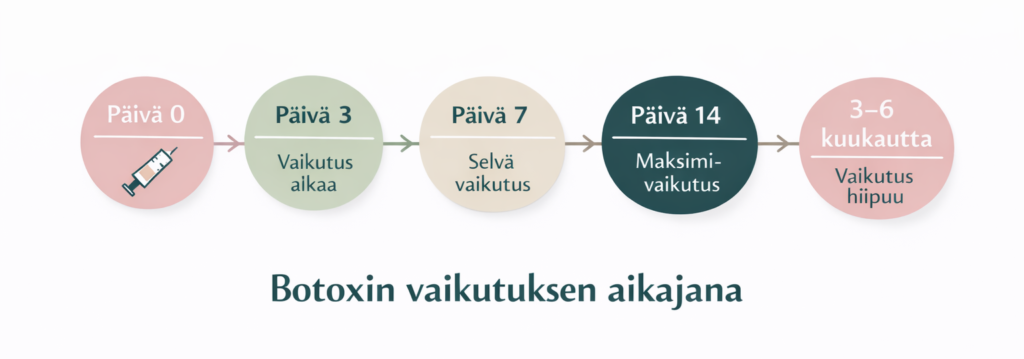
- 3–5 days: first effects
- 10–14 days: final result
The effect does not begin immediately, because the inhibition of neuromuscular transmission occurs in stages.
How long does Botox last?
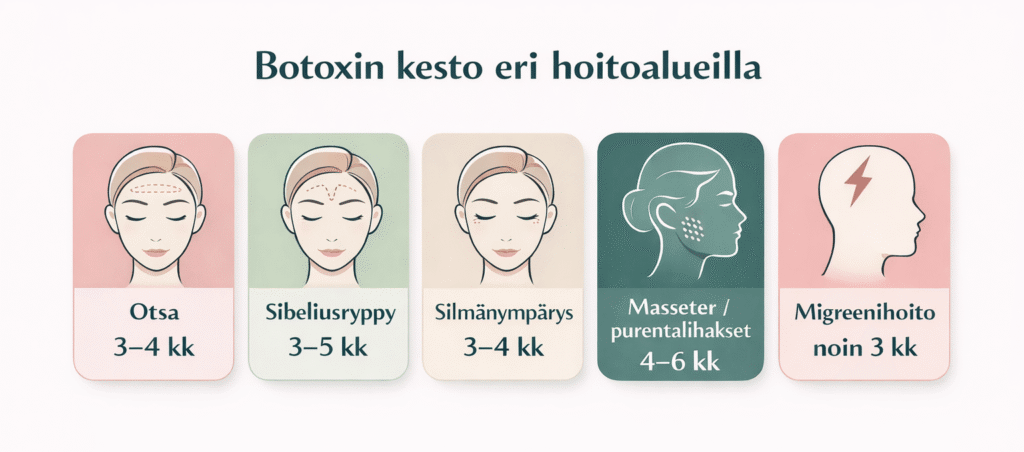
The effects of botulinum toxin usually last 3–6 months.
The duration of the effect depends, among other things, on:
- treatment area
- muscle strength
- of the dose used
You can view examples of the results here:
What are the possible side effects of Botox?
The most common side effects are
-
- redness at the injection site
- mild swelling
- small bruise
Less common are
- muscle weakness in the adjacent area
- eyelid drooping
Serious symptoms, such as difficulty swallowing or breathing, require immediate medical attention.
Is Botox a toxin?
Yes, botulinum toxin is a neurotoxin.
The key factor is the dosage. The amounts used in medicine are very small and safe when the treatment is administered correctly.
Frequently Asked Questions About Botulinum Toxin
Can Botox spread throughout the body?
Botulinum toxin primarily acts locally at the injection site. In rare cases, the effect may spread to adjacent muscles.
Is Botox permanent?
No. The effect lasts 3–6 months, after which muscle function returns to normal.
Is Botox treatment painful?
The injections are administered with a very fine needle. Most people describe the needle pricks as small pinpricks.
Can Botox change the appearance of the face?
Excessive or improperly targeted treatment can affect one's appearance, but when properly planned and executed, the result is natural.
Summary: What is Botox?
Botox, or botulinum toxin, is a medication that temporarily reduces muscle activity.
It is used for both aesthetic and medical purposes:
- for the aesthetic fading of stretch marks
- for the medical treatment of muscle tension and other functional symptoms
The effect is based on the inhibition of neuromuscular transmission, which prevents the muscle from contracting normally.
The effects begin within a few days, peak in about two weeks, and usually last 3–6 months.
When performed correctly, the treatment is safe. Its effects diminish and eventually disappear over time.
Botox is not a filler, and its effects are not permanent. The treatment is precisely targeted, and its goal is always to temporarily regulate muscle function.
Botox treatments in Helsinki
If you're considering Botox treatment, you can read more about the treatments and how to book an appointment here: