
Dental implant – price?
Let's get straight to the issue that probably concerns you the most: how much does a dental implant cost? The direct answer is that the price for a single tooth implant treatment starts at around 2300–2900 euros. However, this is just a starting point. It is important to understand that there is no one-size-fits-all price tag because everyone's mouth and situation are unique.
I am Ville Männistö, a specialist in oral and maxillofacial surgery, and in this article, I will explain what determines the cost of a dental implant. My goal is to give you all the information you need to make a confident decision and avoid hidden costs or other unpleasant surprises.
Each implant patient's treatment is a unique journey. The final cost of a dental implant depends on many factors, such as the condition of the jawbone, the necessary procedures, and the extent of the treatment. Therefore, accurate and reliable price information can only be provided after a free implant consultation.
What determines the cost of a dental implant?
The total cost of a dental implant is like a puzzle consisting of several different parts. Each stage has its own important role in ensuring a successful and lasting result. Let's go through the pieces that make up this journey – the cost of a dental implant.
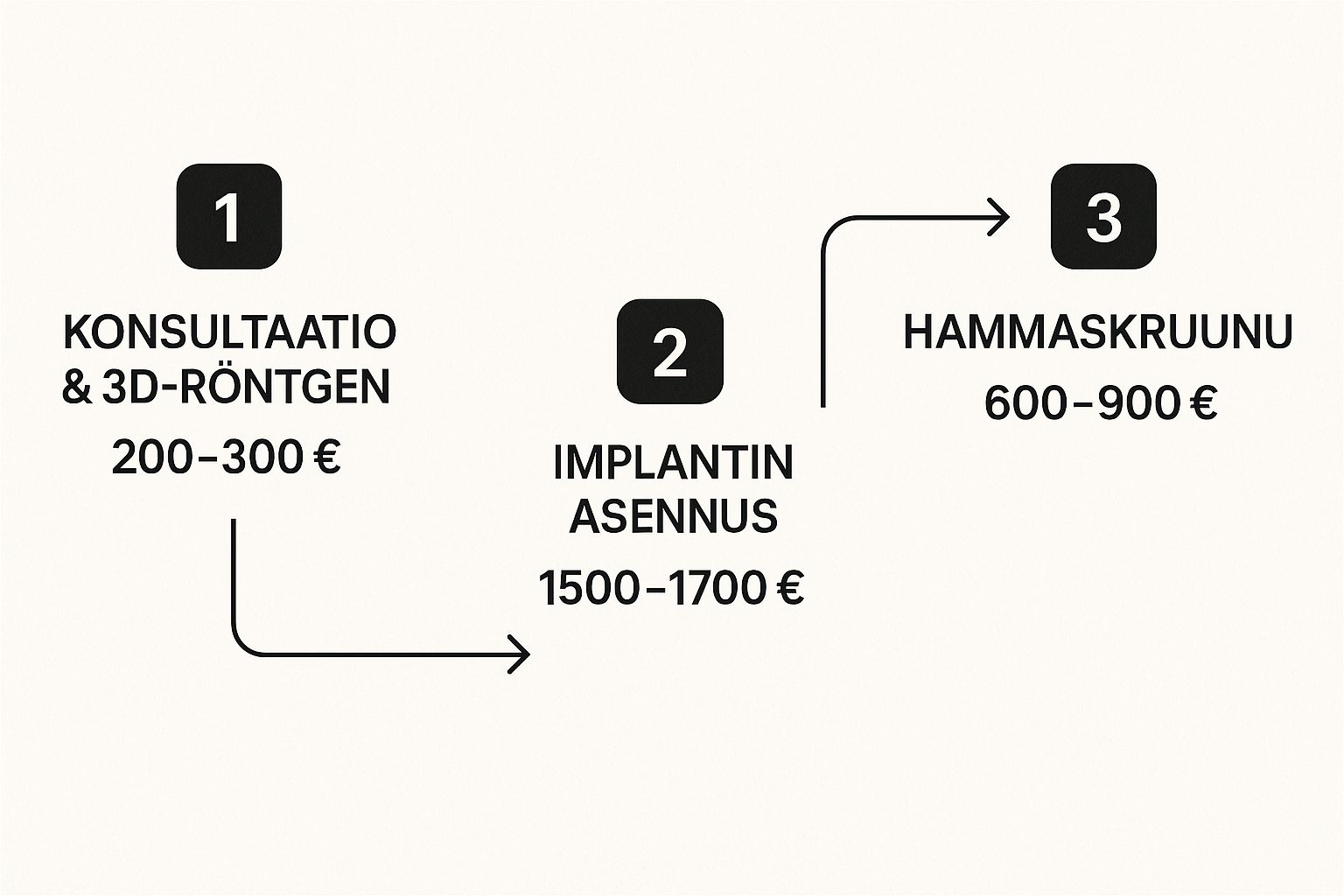
The diagram below illustrates how the total cost of a single implant is typically divided into three main phases: planning, surgical placement, and the final crown.
1. Consultation, examinations, and X-rays
Dental implant treatment begins with careful planning. This is the most important stage of the entire treatment process, as it lays the foundation for everything to come. During the free, no-obligation implant consultation, I will assess the overall condition of your mouth, listen to your wishes, and perform the necessary clinical examinations.
In addition, a three-dimensional CBCT X-ray (cone beam computed tomography) is almost always needed. This 3D image gives me millimeter-precise information about the amount and quality of your jawbone. It is like an accurate map that allows me to plan the implant's location and size safely, avoiding nerve structures, for example.
The planning phase includes:
- clinical examination and assessment of the situation.
- 3D X-ray imaging for accurate planning.
- creating an individual treatment plan and a precise cost estimate.
The cost of this phase is typically around 200–300 euros. It is a small price for peace of mind and the assurance that the treatment is planned correctly from the start.
2. Placing the artificial root (titanium screw)
Once the plan is ready, the surgical phase follows. This involves me placing a titanium artificial root – the implant itself – into the jawbone. This is the core of the procedure and the single largest expense.
The price includes the high-quality titanium implant itself, all the sterile instruments needed for the surgery, anesthetics, and the work of myself and the care team. I only use implant brands that are proven to be high-quality and reliable, and whose long-term research evidence guarantees the best possible prognosis and safety.
The procedure is performed under local anesthesia and is completely painless. The whole process is calm and carefully planned in advance. The price for this stage is approximately 1,500–1,700 euros.
3. Abutment and final crown
Once the actual implant has properly fused to the jawbone – which usually takes 3–6 months – it is time to build the visible part, i.e., the new dental crown. This phase consists of two parts:
- Abutment: this is the connecting piece between the implant and the crown.
- Crown: A custom-made, tooth-like ceramic part manufactured in a dental laboratory, which is attached to the abutment. The crown is perfectly tailored to fit your bite and adjacent teeth.
The price for this prosthetic phase is usually 600–900 euros.
4. Possible additional procedures (bone graft, gum contouring)
An implant cannot always be placed directly. If a tooth has been missing for a long time, the jawbone underneath it may have atrophied. In this case, additional procedures are needed, the most common of which is a bone graft. This involves adding either the patient's own bone or artificial bone to the jawbone to provide a sufficiently strong base for the implant.
A bone graft is the most common reason why the price of a dental implant may be higher than the initial estimate. Depending on the extent of the procedure, it can add costs from a few hundred euros to even over a thousand euros.
Sometimes the gum line also requires aesthetic contouring to make the end result as natural as possible. All possible additional procedures are always assessed during the planning phase and included in the cost estimate, so there will be no surprises. You can read more about this in my comprehensive dental implant article.
Price examples: what does implant treatment cost in practice?
Abstract numbers do not always tell the whole truth. That's why I'll go through a few typical treatment situations to give you a better idea of what price range your treatment might fall into.
Example 1: Single dental implant
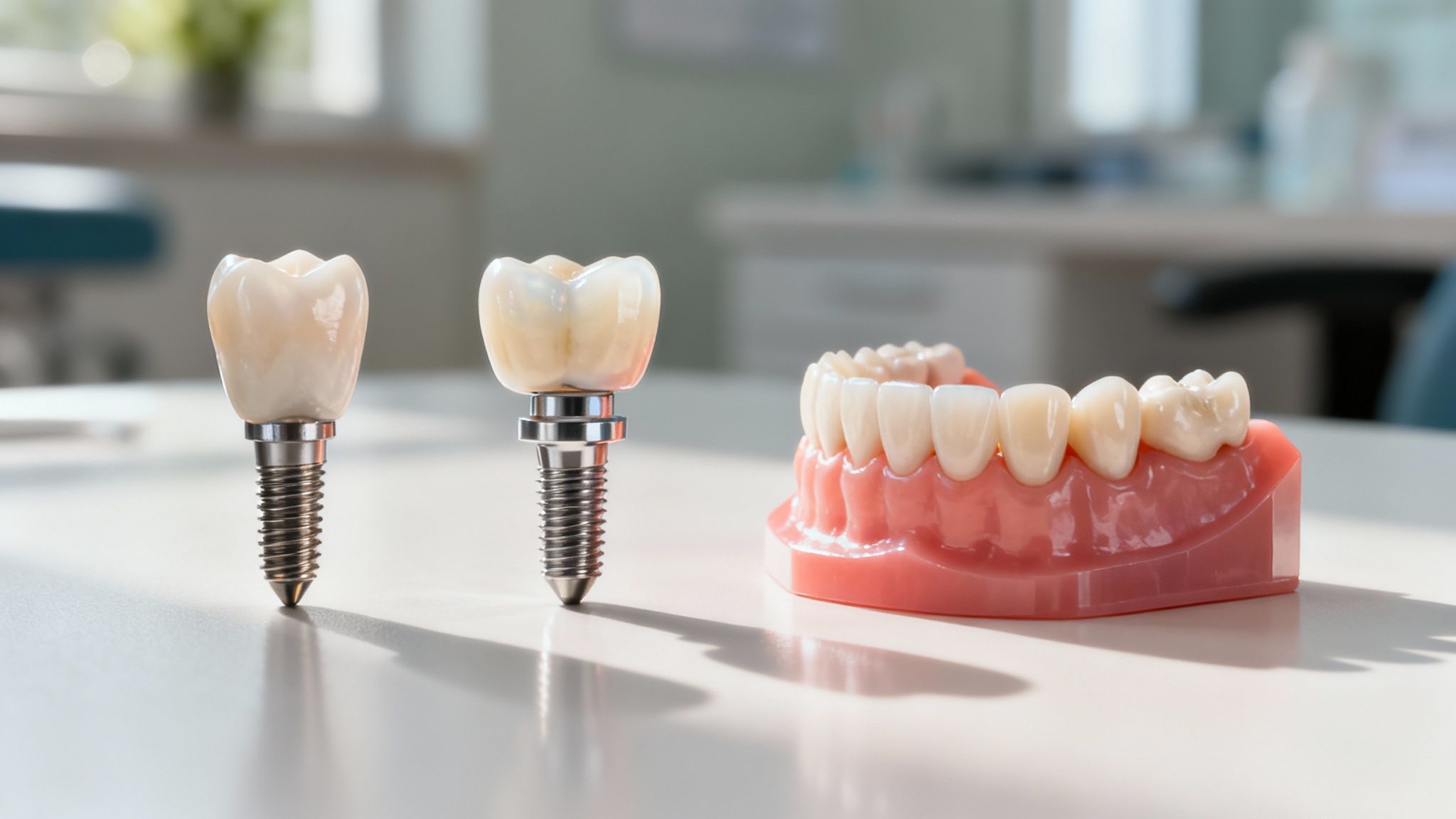
This is the most common and straightforward implant treatment. One missing tooth is replaced with one implant and a ceramic crown on top of it.
- Starting situation: The patient is missing one tooth, but the adjacent teeth are healthy. There is sufficient jawbone, so a bone graft is not needed.
- Treatment: After planning, implant placement, and the healing period, a custom ceramic crown is made and attached to the implant.
- Estimated price: the price of the entire package is typically 2,300–2,900 euros.
This is a superior solution compared to a traditional bridge because the treatment does not require grinding down the adjacent teeth.
Example 2: Multiple teeth implant bridge
If you are missing several adjacent teeth, it is usually not necessary to replace each one with its own implant. In this case, the most cost-effective solution is an implant bridge.
- Starting situation: the patient is missing three consecutive molars.
- Treatment: I place one implant at each end of the gap. Once they have fused, a three-tooth ceramic bridge is built on top of these two implants.
- Estimated cost: The cost of a three-tooth bridge with two implants is approximately 4,500–6,000 euros.
Example 3: Full arch implant treatment
When all the teeth in the upper or lower jaw are missing or need to be removed, the entire dental arch can be restored with a fixed bridge. This is a revolutionary treatment for patients who have suffered from poorly fitting dentures.
- Starting situation: The patient has an edentulous (toothless) lower jaw.
- Treatment: Typically, 4–6 implants are placed in the jaw (All-on-4 or All-on-6 method). A fixed, full-arch bridge is attached to these.
- Estimated cost: The cost of a fixed full-arch solution is naturally higher, starting from approximately 12,000 euros upwards per jaw.
Although the cost of implant treatment may seem high in this case, it is an investment in a completely new quality of life.
Payment and Kela (Social Insurance Institution) reimbursements
It's natural to consider how to finance implant treatment. My goal is to make high-quality treatment accessible to as many people as possible, and to prevent finances from becoming an obstacle.
What can Kela reimburse?
The Kela reimbursement for a dental implant is quite small. Reimbursement is available for certain examinations and the surgical phase itself, but not for the implant materials or the crown, for example. The reimbursement is typically 100–200 euros, so it only covers a small portion of the total costs. Therefore, when planning your budget, you shouldn't rely too much on Kela reimbursement.
Possible payment plans and flexibility
I understand that the price of an implant may seem like a large sum to pay at once. That's why I offer flexible financing solutions and installment options, which allow the costs to be spread over a longer period, in monthly installments that suit your budget. We will carefully review these options during the consultation.
Why is a dental implant a worthwhile investment?
Although the price tag for implant treatment may seem high at first, it's not just an expense. A dental implant is a long-term investment in your health, functionality, and self-confidence.
1. Durable solution (can last for decades)
A high-quality and properly maintained dental implant is designed to last even a lifetime. Traditional bridges and dentures often need to be replaced every 5–15 years. In the long run, an implant is often a very financially sensible choice. According to studies, the use of dental implants has increased dramatically in Finland, which indicates the reliability of the treatment. You can read more about this in this report.
2. Natural appearance and good chewing ability
An implant functions just like your own tooth. It also looks and feels like your own tooth. You can eat what you want and laugh freely without worrying about the denture moving. An implant restores the natural balance of your bite.
3. Prevents bone loss and preserves the natural shape of the face
When a tooth is missing, the jawbone underneath it begins to shrink because it no longer receives natural stress. This can change facial features to look older. A dental implant acts like the tooth's own root and transmits chewing forces to the jawbone. This prevents bone loss. Implant treatment is the only method that preserves bone health.
Sometimes, procedures performed in connection with tooth extraction can prevent the need for more extensive bone grafts later. You can read more about this in my article that discusses tooth extraction and related procedures.
Frequently asked questions (FAQ)
Finally, I will answer some of the most common questions that concern those considering dental implants.
Is an implant expensive compared to a bridge or denture?
Yes, as an initial investment, an implant is more expensive. However, in the long run, it is often the most cost-effective option because it lasts for decades and does not require grinding of adjacent teeth or regular replacement like other solutions.
Can I pay for the implant in installments?
Yes, you can. I offer flexible payment plans and financing options at all my locations, making it easy to spread the cost of treatment over a longer period with manageable monthly installments.
Why do prices vary between clinics?
Many factors influence the price: the quality and research behind the implant brand used, the surgeon's experience and specialization, the clinic's technology, and the general price level of the location. Unfortunately, the cheapest price does not guarantee the best or most lasting result. As stated on the Finnish Consumer Agency's website, there are significant differences in the prices of dental services.
How does the location affect the price of a dental implant?
In larger cities, the general price level may be slightly higher than in, for example, Pori or Hämeenlinna. Price differences are affected by factors such as the clinic's rental costs and local competition.
Take the first step towards a new smile
Now you have a clear picture of what makes up the price of a dental implant. However, the most important thing to remember is that high-quality and safe treatment in the hands of an experienced professional is the best guarantee for a successful outcome.
I perform dental implant treatments safely and with years of experience in Helsinki, Tikkurila, Tampere, Pori, and Hämeenlinna.
The next step is to find out which solution would be best for your situation. The easiest way to do this is to book a free and completely non-binding implant consultation. There, you will receive a personalized treatment plan and a cost estimate. With these, you can proceed with the treatment without any price-related surprises.
Book a free and non-binding implant consultation.
Locations and appointment booking